What Happens When Your Business Is Failing?
When people say their business is failing, what they usually mean is: ‘I’m exhausted and nothing is working.’
There are a looooot of things that go into a business, and sometimes, it feels like herding geese.
Now, look. It’s easy to be hard on ourselves because if we’re being hard, then it’s easier to take when others are being rude. But, this one time, would you listen to me?
You may be okay. With a few easy tweaks, you might be back on course.
Hear me out.

The Hamster Wheel Keeps Churning
I’ve been there and I’ve seen plenty of other businesses that’ve been there, too.
We just keep working harder without moving forward.
Or we keep chasing clients who refuse to pay their invoice and complain about our service - which, admittedly, wasn’t great.
Or we keep fixing things in our business only to discover more things that aren’t working like bad pipes in an 80’s house.
it feels like every win is followed by another fire.
You’re left wondering if you were stupid for starting a business in the first place.
What looks like failure is often misalignment.
You can look at my business, for instance. I started Rippling Roots to create connection content because I love writing blogs. But then AI took off just as I was launching and no one wanted what I had to offer. I’m too expensive when AI can write just as good. So, then I went into strategy and everyone said, “Why do I need strategy when AI can do the same for a lot less.”
And so, I was like, “Do I even have a business?” Not really. I have a service and others have a need, but to get them to understand that, I have to teach them.
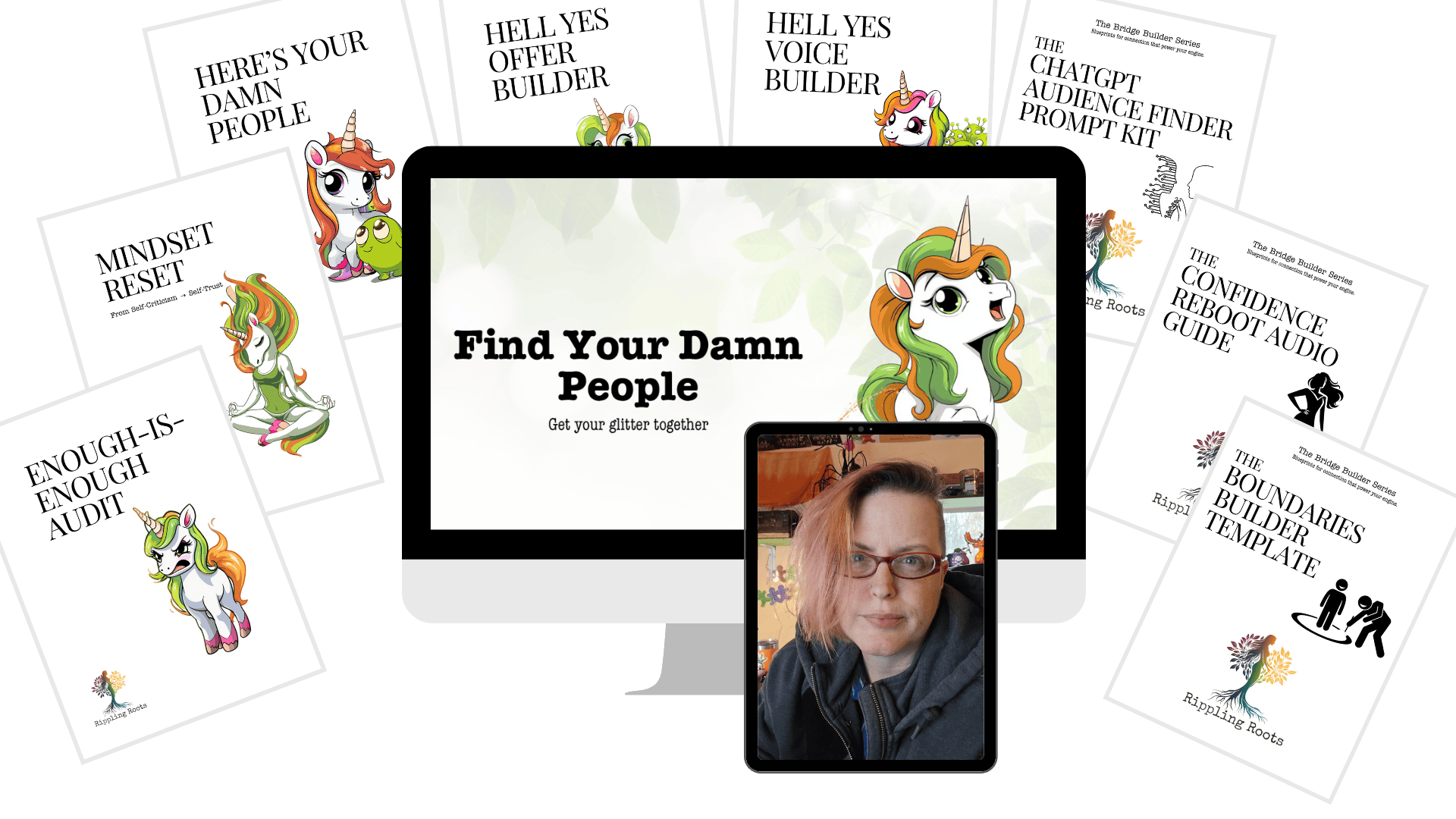
So, that’s what I did. I created an entry-level class that is… powerful. OMG. It’s good if you invest the time to work the steps. But the business is growing as people learn that they’re not always the problem.
Now, look. Some business owners are the problem. But if you’re reading this, chances are—you’re not.
You’re probably misaligned.
Something happened as I was building my class - the Find Your Damned People class. I started giving examples of what I’ve done and the results that came from them and I started to remember that I do actually have experience doing this. I just happened to realign businesses while managing projects or helping departments or bolstering friends. And here’s the thing, no matter the project or industry, when you’re misaligned, things don’t work right.
It’s like chiropractic care but for business.
So, what does misalignment look like?
Let me tell you a story.
There was an electrical contractor in Montana. They were a big deal in Denver, but they went to Bozeman with a handsome smile and a I-got-swagger attitude.
And they were kicked right back out of where they came from.
I tried to tell them that this is cowboy country. You don’t walk in with swagger you don’t have. He wanted to open an electrical shop in Bozeman because he knew it was going to boom - which it did - and he had the expertise.
But he didn’t get the support from the community.
He had skill, experience, and money — but he didn’t understand who he was building for. And that misalignment killed the business.
Misalignment can look like other things, too.
It can look like:
unpaid client invoices
unhappy messages
unable to pay bills
unable to pay payroll - which sucks, btw.
angry clients
angry workers
messy office
messy trucks/trailers/sheds/work areas
frustration/irritation
sleepless nights
tightness in the chest
waking up at 2am in a panic
This isn’t a sign that you suck at business. It just means you need to tweak things to work right.
‘Take what you can get’ becomes the default
When we’re starting out, we build with the tools we have and with the clients we can get. Why? Because we’re trying to get reviews. If we can get reviews, we’re worth it. We have merit. We have proven ourselves.
But what happens when that experience doesn’t bolster reviews? Or good reviews? Or word of mouth?
What happens when you do good and your grow a little, but then you hit this really annoying ceiling and can’t grow past it?
The ‘Take what you can get’ mentality is a starvation tactic that only works in the short-term. This isn’t an endurance strategy. It works to help you see how you want to run your business.
Work you enjoy
Systems you tolerate vs love
How you want to interact with clients
What do you enjoy doing? What processes work best for you? What can you repeat 1,000 times to create your Branded System of approach that makes you stand out?
That’s what this ‘Take what you can get’ mentality is for. It’s to start this process, not to build your business with this as the foundation.
What Changes When You Talk to the Right People?
Let me shed a little light on something. You’re not the most important person in your business. You’re the idea behind your business. It wouldn’t exist as you present it if you didn’t start it. But with you as the “awesome-sauce” of your business, it’s still just an idea.
The key ingredient is… your ideal client.
Stop. Listen. Hear me out.
When you know who you actually enjoy serving - which isn’t Bob because he’s a grumpy old man who only complains because he doesn’t believe women should be out of the kitchen - you create services and offers that support her while being fun for you.
Then you start speaking her language. You start meeting her where she’s at. She’s like, “Wow! Where have you been all my life?” And that panel she’s been ignoring in her garage for the eight years she’s had her house suddenly gets attention because you made her interested in it. You empowered her to take interest instead of buying new appliances again after only three years. You reached out and helped her trust you enough to let you help her with something that you knew was wrong, but she didn’t.
And when you checked out her panel and tightened loose connections, installed a surge protector in her panel, swapped out some receptacles, checked the wiring along her kitchen circuits, and changed out her ceiling fan - which is the one thing she’s the happiest about even though the real safety you offered was in the other stuff you did - she was happy. She worked with you, made sure the house was open for you to work, made sure things were out of the way, gave you an extra day when your electrician’s kid got sick, and even did a parts run for you because she wanted a coffee anyway.
And then she paid her invoice on time.
And then… she told others about you.
And then… you got more clients like her who were easy to work with and paid their bills on time and had great ideas for new projects.
And you were able to build a business on something that felt good and didn’t grind your soul to dust.
This is why I built Find Your Damn People.
Look, I know I’m new. My business doesn’t make a lot of sense to a lot of people. This is borderline woo-woo. But it works.
And I know you don’t want to pay me thousands of dollars to create your content strategy and then design your content. I get that.
So, start small. Take the class. The first thing you’ll do is a quick self-audit so you can see where you stand.
It’s a good litmus test to see if you’re going crazy - which your probably aren’t. I mean, maybe a little, but not over the top.
Then, we get to work. But the end of the class, you’ll know what’s not working, you’ll have a good client profile, an offer that will actually resonate with her and you, and you’ll have a messaging voice that will connect with her.
With tiny tweaks, you can take your great idea and work on systemizing your approach so you’re the expert the people you want to work with resonate with.
And! You’ll collect the type of employees who fit in as well.
You’re not behind. You’re at a turning point.
Sounds cheesy, but it’s real.
I’ve helped many businesses succeed by following this system, and I’ve watched others fail because they refused to shift.
This is an easy first step. It’s low commitment and the class takes a few hours.
If you’re tired of guessing, start here.