Why Your Content Isn't Converting Clients (And 3 Simple Fixes You Can Do Today)

You've been creating content for months. Blog posts, social media updates, email newsletters, the works. You're showing up consistently, sharing valuable tips, and putting yourself out there. But here's the frustrating reality: your content isn't turning into actual paying clients.
Sound familiar? You're not alone. Most female business owners struggle with this exact problem, and it's not because your content isn't good enough. The issue usually comes down to a few simple conversion roadblocks that can be fixed in a single afternoon.
Let's dig into why your amazing content isn't translating to clients, and more importantly, how to fix it today.
The Real Reason Your Content Isn't Converting
Here's what's probably happening: Your ideal client finds your content, loves what she reads, and thinks "This woman knows her stuff!" But then... nothing. She doesn't book a call, doesn't sign up for your newsletter, and doesn't buy your service. She just moves on with her day.
This isn't because she doesn't need what you're offering. It's because your content isn't clearly guiding her toward the next step. Most business owners create content that educates and inspires, but forgets to convert. Your blog post might be incredibly helpful, but if it doesn't tell your reader exactly what to do next, and why she should do it, you're leaving money on the table.
The good news? The gap between content that educates and content that converts is smaller than you think. It usually comes down to three specific elements that you can fix right now.
Fix #1: Rewrite Your Headlines to Show Clear Value
Your headline is the first thing potential clients see, and it's often the last. If your headline doesn't immediately communicate what's in it for her, she'll scroll past faster than you can say "ideal client."
Most business owners write headlines that describe what they do rather than the benefit their client will get. For example:
Instead of: "Social Media Management Services"
Try: "Get Your Evenings Back While Your Business Grows on Social Media"
Instead of: "Website Design for Small Business"
Try: "Turn Your Website Into a 24/7 Sales Machine That Converts Visitors Into Customers"
The difference? The first set tells your reader what you do. The second set tells her what her life will look like after working with you.
Here's a real example that shows this in action: China Expat Health changed their headline from "Health Insurance in China" to "Save Up to 32% on Your Health Insurance in China." That small change increased their lead conversion rate by 79%. Why? Because the new headline immediately answered the question "What's in it for me?"
How to Fix Your Headlines Today:
Start with the outcome: What will your client's life look like after using your service?
Include a specific benefit: Use numbers, percentages, or timeframes when possible
Speak to her pain point: Address the problem she's trying to solve
Test different versions: Try 2-3 variations and see which gets more engagement
Your headline should make your ideal client think, "Yes, this is exactly what I need!"
Fix #2: Transform Your Calls-to-Action From Boring to Irresistible
Your call-to-action (CTA) is where the magic happens, or where potential clients disappear forever. If your CTA is generic, hidden, or unclear, you're essentially telling qualified prospects to look elsewhere.
The biggest mistake? Using weak, generic CTAs like "Submit," "Click Here," or "Learn More." These don't tell your reader what she'll get or why she should take action now.
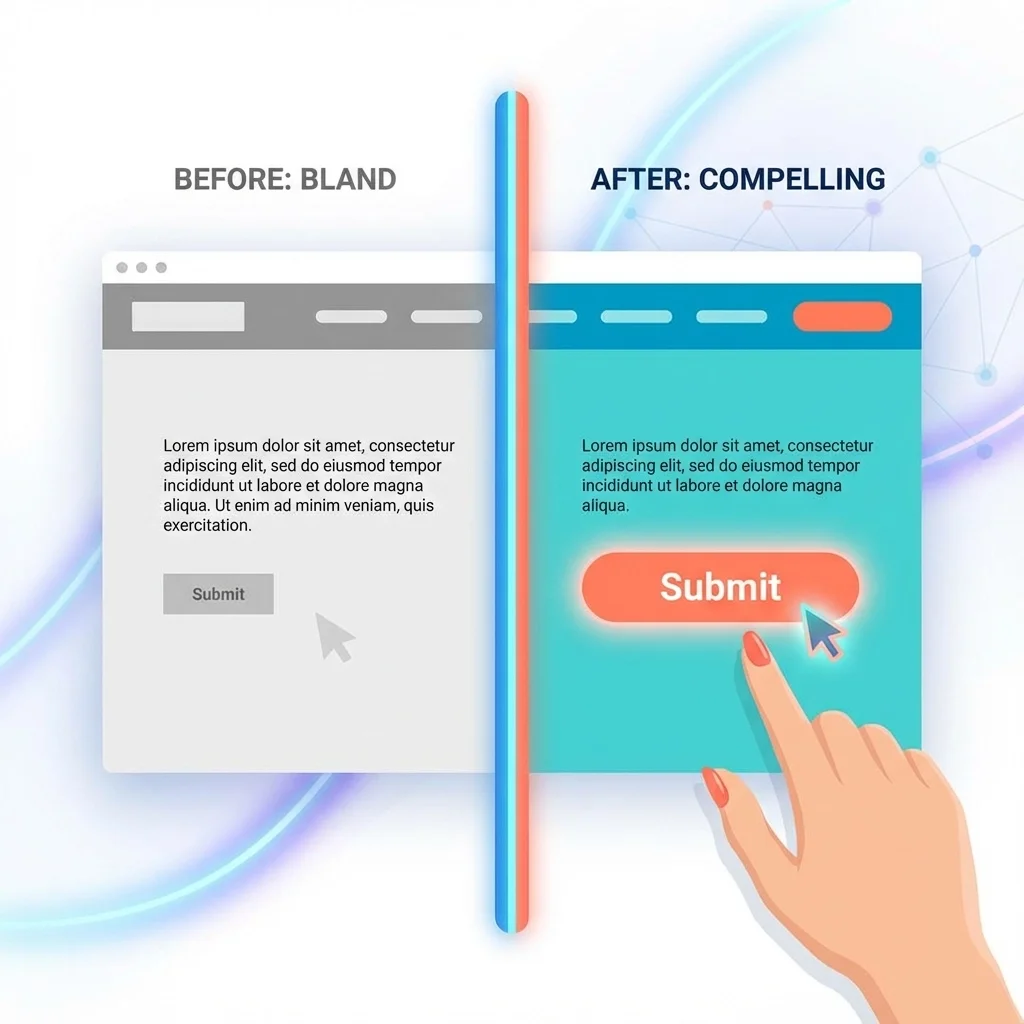
Three CTA Upgrades You Can Make Right Now:
1. Make It Specific and Action-Oriented
Instead of "Submit," try "Get My Free Client Magnet Template" or "Book Your Strategy Call." When Bombas changed their login CTA from a simple icon to clear text, logins increased by 36%, leading to a 4.1% increase in orders. The lesson? Specificity sells.
2. Use Colors That Stand Out
Your CTA button should be the most visually prominent element on the page. If it blends in with your website colors, she might not even notice it. Test bright, contrasting colors that grab attention without being obnoxious.
3. Position It Where She's Already Looking
Don't hide your CTA at the bottom of a 2,000-word blog post. Include it multiple times throughout your content, especially after you've demonstrated value. Think of it as helping her take the next step, not interrupting her reading experience.
CTA Templates That Work:
"Download Your [Specific Tool] Now"
"Reserve Your Spot for [Specific Outcome]"
"Get Started With [Specific Solution]"
"Claim Your [Specific Benefit] Today"
Remember: Your CTA isn't pushy sales language, it's a helpful next step for someone who's already interested in what you offer.
Fix #3: Add Social Proof and Simplify Your Opt-ins
Trust is everything in business, especially for women entrepreneurs who often face extra skepticism from potential clients. If your content doesn't include social proof, you're asking people to take a leap of faith instead of a confident step forward.
At the same time, if your opt-in forms are complicated or ask for too much information, you're creating unnecessary friction. The combination of low trust and high friction is conversion kryptonite.

Adding Social Proof That Converts:
Client Testimonials: Include specific quotes from happy clients near your CTAs. Instead of "Jane was great to work with," use something like: "After working with Sarah, I booked three new clients in my first month. Her strategy made all the difference." , Maria, Wedding Photographer
Numbers and Results: Share specific outcomes when possible. "Helped 50+ female entrepreneurs increase their revenue by an average of 40% in 90 days" is much more compelling than "I help women grow their businesses."
Trust Signals: Display any certifications, awards, or media mentions you've received. These don't have to be huge, even being featured in a local newspaper or podcast counts.
Simplifying Your Forms:
The more fields you require, the fewer people will complete your form. Ask yourself: What's the absolute minimum information you need to serve this person? Usually, it's just their email address and first name.
Hotjar added a simple email opt-in popup on their pricing page and captured over 400 new leads in just three weeks. The key was making it incredibly easy to say yes.
Form Simplification Checklist:
Limit required fields to 2-3 maximum
Clearly explain what they'll receive and when
Make the submit button text specific ("Send Me The Guide")
Consider a two-step process for longer forms
Implementation Strategy: Your 30-Minute Content Conversion Audit
Now that you know what to fix, here's how to implement these changes quickly:
Step 1: Review Your Top 3 Pieces of Content (10 minutes)
Look at your most popular blog posts, landing pages, or social media content. Do they have clear, benefit-focused headlines? Strong CTAs? Social proof?
Step 2: Rewrite One Headline (5 minutes)
Pick your most important piece of content and rewrite the headline using the formula: Outcome + Specific Benefit + Timeframe. Test it and see what happens.
Step 3: Update Your Primary CTA (10 minutes)
Find your weakest CTA and make it more specific. Change the color if needed, and make sure it stands out visually.
Step 4: Add One Piece of Social Proof (5 minutes)
Add a client testimonial, result statistic, or trust signal to your main landing page or most popular blog post.
The beauty of these fixes is that they don't require technical skills or a complete content overhaul. You're simply optimizing what you've already created to work harder for your business.
The Bottom Line: Small Changes, Big Results
Your content isn't failing because it's not good enough, it's probably excellent. The problem is usually in the conversion elements that bridge the gap between "This is helpful" and "I need to work with this person."
By focusing on clear value propositions, irresistible CTAs, and trust-building elements, you can transform your existing content from an expense into your best sales tool. These aren't complicated marketing tactics, they're simple adjustments that respect your reader's intelligence while guiding her toward the help she's already looking for.
Remember: Your ideal clients want to find you. Your job is to make it easy for them to say yes.
Struggling to make your content work for you? Let's build a strategy that actually converts. Schedule your consultation today.